
Non-Surgical • No Downtime • Clinically Proven Results
Regain Confidence & Bladder Control — Without Surgery
Millions of men and women around the world suffer from urinary incontinence, which frequently results in social embarrassment, anxiety, and lifestyle limitations. EMS (Electromagnetic Seat) provides a groundbreaking, non-surgical solution that safely and comfortably restores your confidence. If you are suffering from a prolapse after childbirth, or with a prolapse, you may have tried physiotherapy. If you want to boost your recovery, we can take you as a private referral.

Using advanced High-Intensity Focused Electromagnetic (HIFEM) technology, EMS (Electromagnetic Seat) strengthens the pelvic floor muscles to help you regain control over your bladder, reduce leaks, and enhance intimate wellness — all while remaining fully clothed.
How the EMS (Electromagnetic Seat) Works
Activate Pelvic Floor: The pulses induce contractions in the deep muscles, rebuilding strength and endurance.
Regain control: Bladder control improves over time, and leaks become less frequent or even stop altogether.
Typical Course:
Total of 8 sessions (two per week over 3 weeks)
EMS (Electromagnetic Seat) is an FDA-cleared, non-invasive urinary incontinence treatment designed to improve bladder control by re-educating the pelvic floor muscles. Do you have health conditions that stop you from doing pelvic floor muscle exercises? Pelvic floor dysfunction can occur because of various medical conditions. This can cause urine leaks. Healthcare professionals may encourage you to try pelvic floor exercises. If this is not possible, we have the solution.
This is a common problem, but here at Incontinence Direct, we have treatment options perfect for you.
Each 28-minute session stimulates thousands of supramaximal contractions — equivalent to performing over 11,000 Kegel exercises — to strengthen the muscles that support bladder function effectively.
You sit comfortably on the Ems chair — no pain, no needles, no recovery time. Perfect for pelvic floor weakness, offering great results every time.
For best results, most patients undergo six sessions, scheduled twice a week. It might be advised to schedule maintenance sessions every few months.
If you want to improve your quality of life, book a consultation today to discuss your specific needs. From urge incontinence, stress incontinence, overflow incontinence, and to improve your sexual health. We offer effective urinary incontinence treatment and an Emsella alternative for a weak pelvic floor.
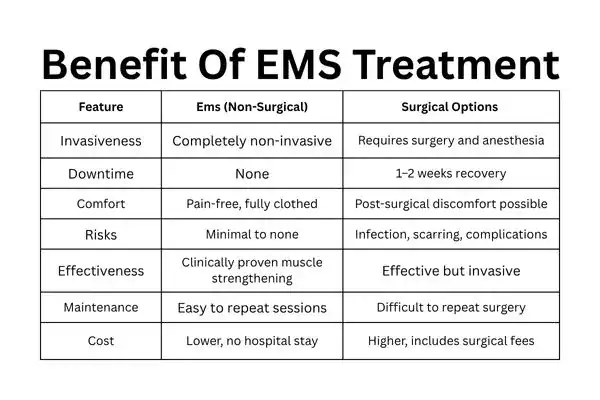
EMS (Electromagnetic Seat) vs Surgical Treatments
The Ems chair offers a safe, comfortable, and convenient alternative to surgery with proven results and zero downtime.
Who Can Benefit from EMS (Electromagnetic Seat)?
The Electromagnetic Seat, or EMS, is intended for people who leak urine.
It works well for:
Men who have had prostate surgery, women who are going through menopause, or who have recently given birth.
It is a common condition. If you want to combat urgency and frequent urination, contact us today.
Stress, urge, or mixed incontinence sufferers; anyone seeking a non-surgical means of strengthening their pelvic muscles
If you experience leaks when coughing, laughing, sneezing, or exercising, the EMS (Electromagnetic Seat) can help reduce these occurrences.
Patient Testimonials
“I saw a significant change after only a few sessions. I don’t have to worry about leaks anymore as I go about my day.
— Sarah M.
“My life was transformed by EMS (Electromagnetic Seat).” Just outcomes, no pain or surgery. I regret not knowing about it sooner.
Michael T.
1. What does it actually do for urinary incontinence?
EMS (Electromagnetic Seat) — This technique uses electromagnetic energy to contract and strengthen pelvic muscles, enhance bladder control, and reduce leaks.
2. Does EMS (Electromagnetic Seat) hurt?
No. Patient safety is paramount, and the vast majority experience only mild tingling or tightness in their muscles, but no pain or discomfort.
3. How many treatments will I require?
For best results, most patients undergo six sessions, scheduled twice a week. It might be advised to schedule maintenance sessions every few months.
4. Is EMS (Electromagnetic Seat) suitable for men?
Yes. Male Urethral Incontinence EMS can benefit male urethral incontinence and post-prostatic surgical management.
5. Are there any side effects?
EMS (Electromagnetic Seat) No recovery time & Minimal Side effects. Some patients experience mild muscle soreness akin to that felt after exercise.
6. When will I see results?
Most people feel better after one or two sessions, with improvement continuing throughout the treatment plan.
7. How long do the results last?
Results typically last 6–12 months or longer. Maintenance sessions help sustain pelvic strength and bladder control.