
Regain Confidence and Control — Without Surgery or Downtime
If you experience bladder leaks when laughing, coughing, sneezing, or exercising, you may be suffering from stress urinary incontinence (SUI) — one of the most common yet treatable pelvic floor conditions.
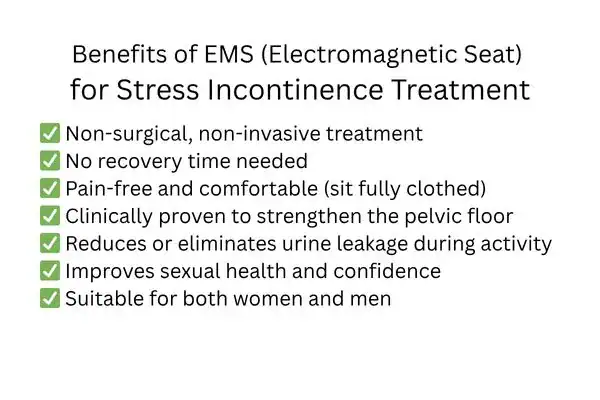
With EMS (Electromagnetic Seat), you can strengthen your pelvic floor muscles naturally, without Surgery, pain, or recovery time. This breakthrough treatment helps restore bladder control and confidence — all while you sit comfortably, fully clothed.

Stress incontinence occurs when physical activity or increased pressure (such as sneezing or exercise) causes unintentional urine leakage. It is frequently brought on by weak pelvic floor muscles, which are commonly brought on by ageing, menopause, or childbirth.
These muscles support the bladder and urethra. When they weaken, even minor stresses can cause leakage. EMS (Electromagnetic Seat) directly targets and rebuilds these muscles — helping you regain control naturally.
Specialist nurses can assist you with pelvic floor exercises. These only help stop urine leakage to a certain point. If you experience pelvic floor dysfunction, you cannot stop the flow of urine. You may also experience bowel problems. Pelvic floor muscle training can greatly improve your quality of life. It is possible even with pelvic organ prolapse or more serious medical conditions.
We deliver excellent standards of care and essential urological care to every patient. From your initial consultation through your personalised plan of care, our professional team ensures you receive the best possible care in a setting that values dignity, privacy, and strict confidentiality agreements under the Data Protection Act.
EMS (Electromagnetic Seat) uses High-Intensity Focused Electromagnetic (HIFEM) technology to stimulate deep pelvic floor contractions — the kind you can’t achieve voluntarily.
Each 28-minute session delivers the equivalent of over 11,000 Kegel exercises, re-educating your pelvic floor and strengthening bladder control. Your individual needs can be covered in a consultation. Your consultant can discuss the severity of your symptoms and advise a treatment course. Here, we can discuss the treatment option that best suits you and create a course of sessions to address your symptoms. In this consultation, we will discuss your medical history and any bladder irritation you may experience.
During treatment:
Typical course:
8-10 sessions (2 per week over 3 weeks) for optimal results. This depends on the type of incontinence you have. From overflow incontinence, urge incontinence, and overactive bladder syndrome, we can help improve your bladder function.
Q1: Is EMS (Electromagnetic Seat) safe for stress incontinence?
Indeed. The FDA has approved EMS (Electromagnetic Seat), which has been clinically shown to treat stress urinary incontinence safely and effectively. There are no side effects. Patients find they use a lot fewer incontinence products even after the first treatment.
Q2: Does EMS (Electromagnetic Seat) really work?
Studies show that most patients report significant improvement — or complete resolution — of incontinence after six sessions.
Q3: How soon will I notice results?
Many patients notice improvement after just 1 or 2 sessions, with continued progress throughout the treatment course.
Q4: Is EMS (Electromagnetic Seat) painful?
Not at all. You’ll feel gentle muscle contractions and tingling, but no pain.
Q5: What is the duration of the results?
Usually, results last six to twelve months. You can maintain your pelvic strength and results with maintenance sessions.