ERECTILE DYSFUNCTION
Erectile dysfunction: understand the condition and your options
Erectile dysfunction (ED) means being unable to get or keep an erection suitable for sex. It can have physical, psychological or medication-related causes, so recurring problems deserve appropriate assessment rather than being assumed to be a pelvic-floor issue.
Your information is treated with care.
Understand your options, with no pressure.
We’re here to help you understand the service and ask questions.
COULD THIS SOUND FAMILIAR?
Common signs of erectile dysfunction
ED can show up in different ways. Some men have difficulty getting an erection, while others can get one but find it difficult to maintain it for long enough for sex.
Leakage with activity
Leakage may occur during activities such as coughing, laughing, sneezing or lifting.
A sudden need to urinate
A strong or sometimes difficult-to-delay need to urinate, which can lead to leakage.
A combination of both
You may experience both stress-related and urgency symptoms at different times.
When to seek advice
If symptoms are new, worsening or affecting daily life, consider speaking with your GP or another qualified healthcare professional.
What is erectile dysfunction?
Difficulty getting an erection
Difficulty keeping an erection
Symptoms worth discussing
Established treatments and private service options
Assessment
A GP or sexual health professional can review your symptoms, health history, medicines and relevant risk factors.
Established ED treatments
Psychological support
Counselling or therapy can be useful when psychological or relationship factors are contributing to erection problems.
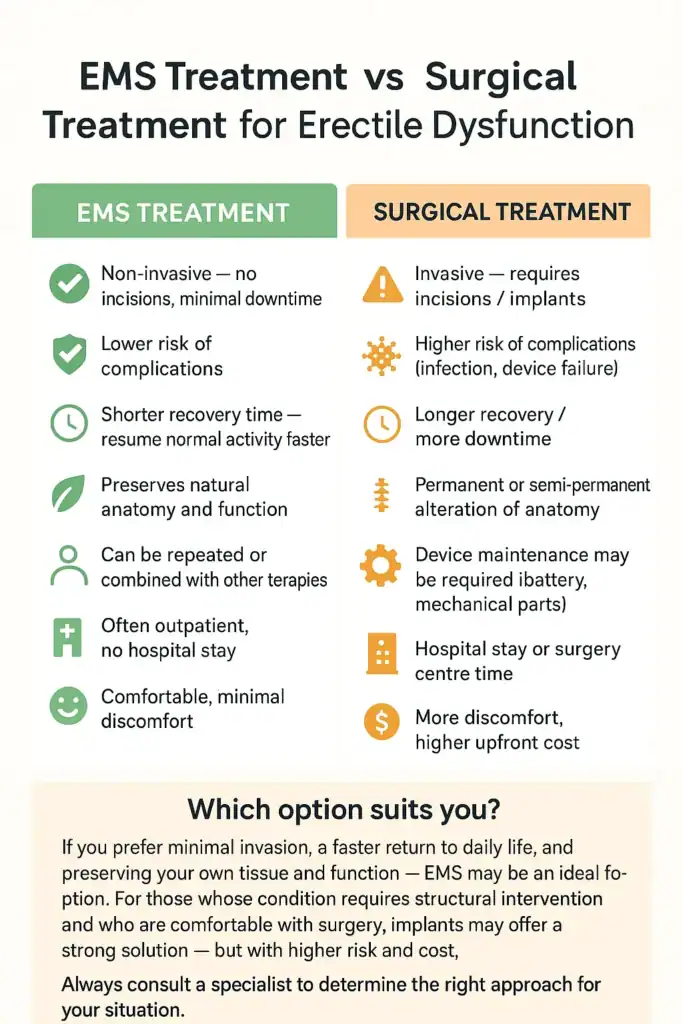
Discuss private EMS separately
Incontinence Direct Exeter provides a private mobile electromagnetic pelvic-floor stimulation service. Evidence for electrical or magnetic stimulation should not be treated as evidence for every electromagnetic system, so suitability and expectations need to be discussed carefully.
Medical assessment remains important when ED is persistent, unexplained or associated with other symptoms.
IF YOU’RE CONSIDERING PRIVATE EMS
A straightforward process
Consultation
Discuss what you would like to know about the service and provide relevant information about your circumstances.
Suitability
Relevant suitability information is considered before treatment is arranged. Where medical assessment is appropriate, you should seek advice from a qualified healthcare professional.
Treatment
If you decide to proceed and the service is considered suitable, the treatment is delivered using the equipment and protocol used by Incontinence Direct Exeter.
TAKE THE NEXT STEP
Book a confidential consultation
Get clear information about the private service, the research that has been published and the questions you may want to ask before deciding whether to proceed.
SUITABILITY & SAFETY
Important information
ED can have different causes and can sometimes be associated with an underlying health problem. Persistent or recurring erection problems should be discussed with a GP or sexual health service. Private EMS is not automatically suitable for everyone.
Key considerations
Persistent ED may need medical assessment
Do not assume electrical, magnetic and electromagnetic stimulation are interchangeable
Seek professional advice if you have concerns about the cause of ED
If erection problems keep happening, the NHS advises seeing a GP or sexual health clinic. Recurring ED can sometimes be a sign of an underlying health condition that can be treated.
Your questions, answered
Clear answers about erectile dysfunction, recognised treatment options and where the private EMS service fits.
What does mixed urinary incontinence mean?
Erectile dysfunction means being unable to get or keep an erection suitable for sex. Occasional problems can happen, but recurring ED is worth discussing with a healthcare professional.
Source: NHS — Erectile dysfunction
How can stress and urgency symptoms occur together?
ED can be associated with stress, tiredness, alcohol, some medicines and health conditions such as high blood pressure, high cholesterol, diabetes or hormone problems. The cause is not always the same from one person to another.
Source: NHS — Erectile dysfunction
How is mixed urinary incontinence usually managed?
The NHS describes medicines such as PDE-5 inhibitors as the main treatments for ED. Vacuum pumps can also be used when medicines are unsuitable or do not work, and treating an underlying cause may help. Psychological support can be relevant where emotional or relationship factors contribute.
Source: NHS — Erectile dysfunction
Is pelvic-floor muscle training relevant to mixed symptoms?
If erection problems keep happening, the NHS advises seeing a GP or sexual health clinic. Recurring ED can sometimes be linked to an underlying condition that needs assessment or treatment.
Source: NHS — Erectile dysfunction
Can bladder training be used when urgency is part of mixed incontinence?
Research has investigated electrical and magnetic stimulation for ED, but these interventions are not interchangeable. A 2025 systematic review of electrical stimulation included three randomised trials involving 82 men and concluded that the evidence was inconclusive, with very low certainty because of small samples, risk of bias and clinical differences between studies. A separate 2025 study investigated a specific flat magnetic stimulation device in 40 men; that study cannot establish the same results for every electromagnetic system or for Incontinence Direct.
Sources: PubMed — Electrical stimulation systematic review · PubMed — Flat magnetic stimulation study
Where does private EMS fit if I have mixed urinary incontinence?
No. Suitability depends on individual circumstances and the specific equipment, protocol and safety information involved. Incontinence Direct does not diagnose the cause of ED or guarantee an outcome from its private service.
Further information: NHS — Erectile dysfunction
Reliable. Evidence-informed.
Information on erectile dysfunction is based on recognised health guidance and published research. Research on electrical, magnetic and electromagnetic stimulation is described cautiously because different technologies and protocols cannot automatically be treated as equivalent.
Incontinence Direct Exeter is an independent provider.
The NHS and NICE links are provided as information sources. They do not represent endorsement, affiliation or approval of Incontinence Direct or its private service.